
Reviewed · BUENOS AIRES WALKING TOURS
Best of Buenos Aires Private Walking Tour
Buenos Aires reveals itself best in its buildings and street stories. This private walk links downtown’s Florida Street with Recoleta’s palaces and cemetery, showing how British money, French taste, Italian and Spanish immigration, church power, and Argentine politics shaped the city. The route covers at least 25 sights, but the real prize is the explanation connecting them.
I like the mix of famous landmarks and odd details, from Corina Kavanagh’s 14-month skyscraper project to a former British livestock auction house now serving as an upscale mall. I also like the private format, which lets you ask questions and set the rhythm. The main drawback is simple: this is 2.5 to 3 hours of solid walking, and the full route may change with weather, strikes, repairs, or city events.
In This Review
- Key points at a glance
- From Florida Street to the Paris of the South
- Kavanagh and Plaza San Martín
- Palaces built for ambition and status
- Difficult history along elegant streets
- Recoleta and Avenida Alvear
- A full hour in Recoleta Cemetery
- Ending at La Biela
- What the private format is worth
- Pace, weather, and practical planning
- Who will enjoy this walk most
- Should you book the Best of Buenos Aires Private Walking Tour?
- FAQ
- Where does the tour begin?
- Where does the tour end?
- How long does the tour last?
- Is Recoleta Cemetery admission included?
- Are hotel pickup, drop-off, or meals included?
- Does the tour operate in bad weather?
Key points at a glance
- Downtown to Recoleta on foot: The route crosses several distinct parts of Buenos Aires instead of staying in one sightseeing zone.
- Architecture with context: Kavanagh, Paz, San Martín, Estrugamou, and other grand buildings come with stories about money, ambition, and social power.
- A serious look at Argentina and Britain: The Monumental Tower and Malvinas memorial open a discussion about economics, politics, and the Falklands War.
- Recoleta Cemetery is included: Plan for a detailed visit focused on Evita Perón, artists, military figures, scandals, and family fortunes.
- A private English-speaking guide: Only your group participates, with past guides including Martin, Carlos, and Mariano.
- A useful first-day orientation: The route ends at La Biela in Recoleta, close to restaurants and major sights for further exploring.
From Florida Street to the Paris of the South
Meet outside Florida Garden at Florida 899, near the corner with Paraguay Street, no later than 10 a.m. Look for the guide carrying or wearing a small Buenos Aires Walking Tours sign. The tour begins with a short introduction before heading along Calle Florida, one of the city’s oldest shopping streets.
Florida Street connects the foundational center near Plaza de Mayo with Plaza San Martín. It is an active commercial corridor, but this walk treats it as a history book written in pavement and storefronts. Your guide explains how the street fits into the early development of Buenos Aires and points out details easy to miss when you are shopping or simply trying to cross town.
The first architectural stop is the Basilica del Santísimo Sacramento. Mercedes Anchorena commissioned the church for her family, and it was completed in 1916. The building gives your guide an opening to discuss the city’s old elite, including the overlap of wealth, family rivalry, social ambition, and church influence.
More walking tours in Buenos Aires:
- Buenos Aires Hop-On Hop-Off Bus, Free Walking Tours & Discounts
★ 4.5 · 2,218 reviews - Buenos Aires: La Boca Guided Walking Tour in English
★ 4.8 · 1,587 reviews - Nazis in Buenos Aires: a historical walking tour
★ 4.9 · 193 reviews
Kavanagh and Plaza San Martín
The Edificio Kavanagh is one of the tour’s strongest early stops. This Art Deco skyscraper looks over Plaza San Martín and was once the tallest building in Latin America. It was commissioned in 1934 by Corina Kavanagh, an Irish-Argentine millionaire who sold two ranches at age 39 to finance the project.
The building was completed in only 14 months. That fact alone makes the story memorable, but the guide also uses Kavanagh to explain how private fortunes shaped Buenos Aires. You will not tour the interior, so this is an exterior architecture stop, best appreciated from the plaza.
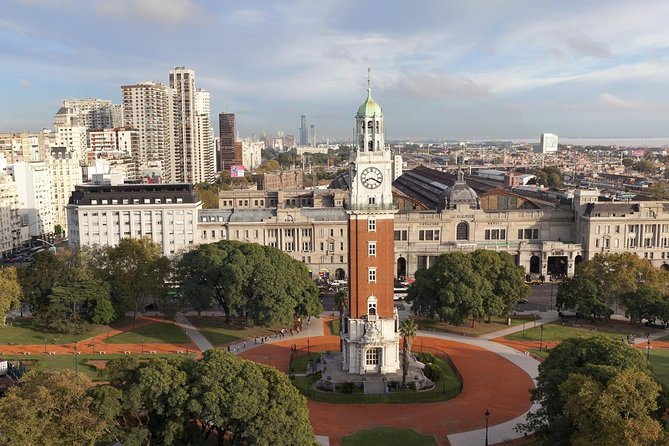
Next comes the Torre Monumental, the British Clock Tower. Its presence helps explain Argentina’s long economic relationship with Britain. The nearby Monumento a Combatientes de Malvinas adds a very different layer: the 1982 war over the Falkland Islands, called the Malvinas in Argentina.
This pairing is useful because it avoids a simple tourist version of the city. You see a British-style monument while hearing about Argentine resentment, British commercial influence, and the political weight of the war. It is one of the places where architecture and national memory sit side by side.
Plaza General San Martín brings the focus back to Argentina. The park once held a fort, a bullfighting ring, and areas connected with the city’s early slave trade. Today, its central monument honors General José de San Martín, the country’s principal independence hero. The guide tells his story while placing the park in the wider development of Buenos Aires.
Palaces built for ambition and status
The Palacio Paz looks like a French city palace because much of its material was imported from France. José C. Paz, a newspaper owner and aspiring president, built the enormous residence in 1914. Its reported 120 rooms were intended for a family of four, which tells you plenty about the scale of the era’s elite ambitions.
The nearby Palacio San Martín was originally the Anchorena family palace. Its current name reflects later political use, but the guide brings the story back to Mercedes Anchorena and her role in commissioning the nearby Basilica del Santísimo Sacramento.
These stops are valuable for first-time visitors because they explain more than style. Buenos Aires did not simply copy Paris for decoration. The city’s upper class used French architecture, imported materials, grand avenues, and elaborate residences to announce power and position during Argentina’s prosperous years.
The Palacio Estrugamou continues the same theme in Barrio Norte. Parisian apartment buildings and ornate residences fill this part of the city, giving Buenos Aires its familiar European look. The guide connects the buildings to immigration from Spain, Italy, France, and Britain, as well as the country’s rise and later decline.
Difficult history along elegant streets
This is not a tour that avoids hard subjects. At Plaza de la Embajada de Israel, you hear about the 1992 bombing of the Israeli embassy, which killed 24 people. The stop also opens a discussion about Argentine politics, justice, and the aftermath of the attack.
The former Ortiz-Basualdo Palace, now the French Embassy, supplies a lighter dose of historical gossip. One story concerns Edward VII of England and his visit with his American future wife. These details keep the walk from becoming a string of dates and building names.
Patio Bullrich offers another sharp turn. The elegant shopping center began life in 1867 as a British-influenced auction house designed by English-Argentine architect Juan Waldorp. The Bullrich family used it for livestock sales, including prize bulls and thoroughbreds, along with valuable heirlooms and collectibles.
Today, you can browse a polished shopping center, but the building’s earlier purpose helps explain the links between British capital, cattle, land, and Argentine wealth. You get a useful reminder that the city’s grand architecture grew from commerce as much as from culture.
The Apostolic Nunciature adds the church to the story of privilege. The palace was donated to the Vatican by Adelia Harilaos, and your guide explains why Argentina produced a pope and how wealthy women such as the Anchorena, Harilaos, and Alvear families supported religious institutions.
More ways to see Buenos Aires in a day:
- Buenos Aires: City Highlights Guided Tour with Transfer
★ 4.7 · 1,946 reviews - Buenos Aires: Hop-On Hop-Off City Bus Tour
★ 4.2 · 1,855 reviews - Buenos Aires Hop-On Hop-Off Bus and Exclusive Benefits
★ 4.4 · 1,714 reviews - Best of Buenos Aires: Guided Sightseeing City Tour
★ 4.0 · 402 reviews
Recoleta and Avenida Alvear
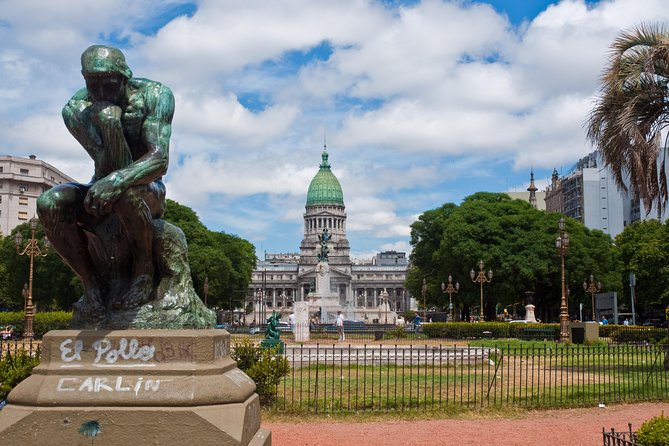
As the walk reaches Recoleta, the tone changes. The neighborhood grew around land given to Franciscan Recoletos monks. Today, it is known for former palaces, Paris-style townhouses, expensive shops, and some of Buenos Aires’ most polished streets.
Avenida Alvear is the grandest stretch of the route. Its mansions reflect the period from roughly 1880 to 1930, when immigration, exports, and elite wealth transformed Argentina. The guide uses the avenue to explain the country’s social and economic rise, then the later loss of that position.
I find this section especially useful because it gives you a way to read the city after the tour. Once you understand why these mansions were built, Recoleta becomes more than an attractive neighborhood. Its architecture records a period when Argentina’s ruling families wanted Buenos Aires to look unmistakably European.
The Basilica de Nuestra Señora del Pilar is included in the tour. Completed in 1732 as part of the Franciscan Recoletos monastery, it is the second-oldest church in Buenos Aires. Admission here is included, unlike some exterior stops where you simply view the building from the street.
A full hour in Recoleta Cemetery
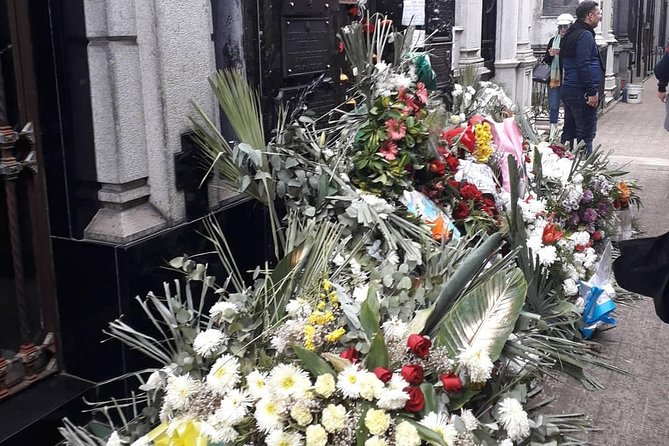
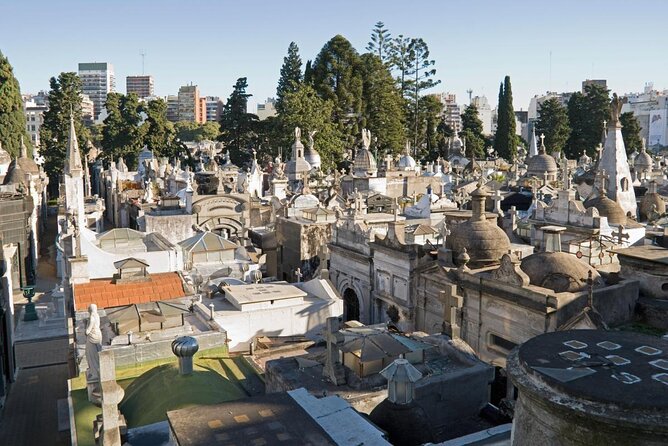
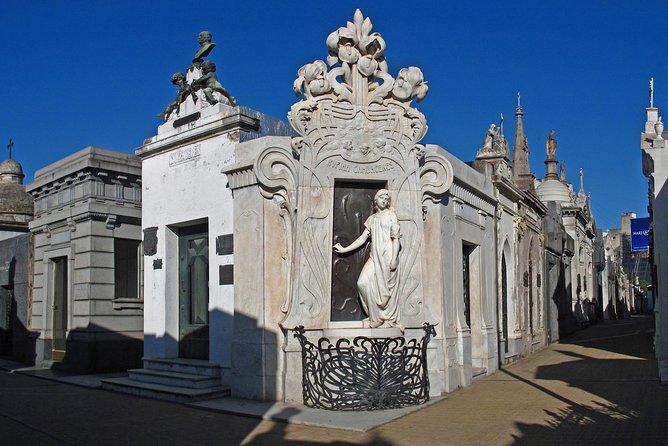
The cemetery is the tour’s longest stop, with about an hour planned for a detailed visit. This is not merely a quick walk to Evita Perón’s tomb. The guide covers her memorial and life, along with stories about Rufina Cambaceres, Tiburcia Domínguez, Admiral Brown, the wealthy Leloir family, General Guido, Liliana Crociatti, and other figures.
The cemetery’s value comes from the way its tombs turn national history into personal stories. Military leaders, political figures, artists, wealthy families, and tragic characters appear in one compact city of mausoleums. You also hear about social customs, family fortunes, and the way Argentines remember public figures.
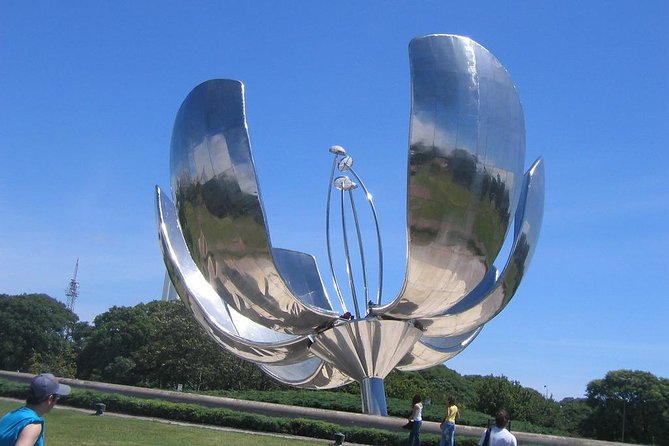
The wider Recoleta visit can include the old monastery and cultural center, Bourdelle’s monument to Alvear, the Palais de Glace and its connection to tango, the history of tango, port life, and immigration. The route may also point out the Buenos Aires Design Center, terraces, the giant flower when available, Palermo Chico, the National Library, Loma Mitre, the monument to France and Argentina, and the National Fine Arts Museum.
The wording around this section matters: the full list depends on time and circumstances. If your guide spends longer on a cemetery story or city event slows the walk, some side sights may receive less attention. You should treat the route as a broad introduction rather than a guarantee of equal time at every location.
Ending at La Biela
The walk ends outside La Biela, the famous café at Avenida Presidente Manuel Quintana 596. Your guide explains the café, the neighborhood, and nearby attractions before leaving you to choose what comes next.
This is a practical ending. Recoleta is one of Buenos Aires’ main restaurant and sightseeing districts, so you can continue on your own instead of being dropped in an unfamiliar residential area. One past participant found the walk so extensive that returning to the hotel meant another hour on foot, so check your map before starting and plan a taxi or public transport if your accommodation is far away.
What the private format is worth
The price is $109 per person. That is not the bargain choice for a quick orientation, but it can be good value if you want a personal guide, a focused history lesson, and the flexibility of a private group. The cemetery admission is included, as is a professional English-speaking guide. Meals, hotel pickup, and hotel drop-off are not included.
The price makes the most sense for two or more people who care about architecture, politics, and social history. A private guide can answer questions about a particular building, explain local customs, or slow down when you need a closer look. It also avoids the fixed group dynamic of a large scheduled walk.
Past guides named in feedback include Martin, Carlos, and Mariano. Martin received especially strong praise for his humor, excellent English, and ability to explain social, economic, and political history. Carlos was described as experienced and amusing, while Mariano was praised for showing less obvious parts of the city. Guide availability is not guaranteed, but the comments suggest that guide quality is central to the experience.
The tour is booked an average of 59 days ahead, so last-minute availability may be limited. Confirmation arrives within 48 hours, subject to availability. Free cancellation is available up to 24 hours before the start time, but changes or cancellations inside that window are not refunded.
Pace, weather, and practical planning
The stated duration varies between about 2.5 hours and 3 hours. In practice, you should plan for the longer figure, especially if your guide spends time answering questions or covering the cemetery in detail.
You need to be comfortable walking continuously through downtown and Recoleta. One account described a cracking pace, while others found the walk leisurely or manageable. That difference may reflect the guide, the size of the group, or the amount of discussion, so tell your guide early if you need a slower rhythm.
The tour runs rain or shine. Wear shoes suitable for long city walking and bring weather protection. The full route can be affected by rain, public repairs, strikes, demonstrations, or other city conditions, so the advertised list of sights is best understood as the intended route, not an absolute promise.
Children aged eight and under are free when accompanied by an adult. Most people can participate, and the route is near public transportation, but there is no hotel transfer. You arrange your own way to Florida Garden and from La Biela.
Who will enjoy this walk most
I would choose this tour early in a Buenos Aires stay if I wanted a strong sense of the city’s structure. It gives you downtown shopping streets, a major plaza, palaces, churches, embassies, a former auction house, a grand avenue, and Recoleta in one continuous route.
It suits you if buildings are more interesting when you know who paid for them and why they were built. It also works well if you enjoy political and social context rather than only photo stops. The Falklands War, the Israeli embassy bombing, immigration, church power, tango, and Argentina’s changing fortunes all appear along the way.
It may not suit you if you want a relaxed café crawl, extensive time inside museums, or a short route with frequent breaks. The cemetery portion is detailed, and the walk crosses a large section of the city. You should also know that one past participant felt the guide devoted too much time to promoting other tours and did not respond fully to questions. That was not the common pattern, but it is a fair reminder to speak up and steer the conversation toward what interests you.
Should you book the Best of Buenos Aires Private Walking Tour?
Book it if you want a compact but serious introduction to Buenos Aires, especially its architecture, old fortunes, British connections, immigration, and Recoleta Cemetery. The private setup and included cemetery entry help justify the $109 price when the tour fits your interests.
Skip it if you dislike long walks or prefer to explore one neighborhood slowly. For most first visits, though, this is a useful way to get your bearings, learn the stories behind the facades, and finish in Recoleta with plenty of options for lunch, coffee, museums, and further wandering.
FAQ
Where does the tour begin?
It begins outside Florida Garden at Florida 899, near the corner with Paraguay Street in Buenos Aires. Meet no later than 10 a.m. and look for a guide with a small Buenos Aires Walking Tours sign.
Where does the tour end?
The walk ends outside La Biela café at Avenida Presidente Manuel Quintana 596 in Recoleta.
How long does the tour last?
The experience is described as approximately 3 hours, while the walking portion is also described as about 2.5 hours. Plan for roughly 2.5 to 3 hours.
Is Recoleta Cemetery admission included?
Yes. Cemetery admission is included in the tour price, along with a professional English-speaking guide.
Are hotel pickup, drop-off, or meals included?
No. You must make your own way to the starting point and arrange transportation after the walk. Meals are not included.
Does the tour operate in bad weather?
Yes. The tour operates rain or shine, but weather, strikes, repairs, demonstrations, and other city conditions may affect how much of the planned route is covered.
Just added around Buenos Aires
- Unique Tigre and Delta Private Day Cruise Navegation★ 5.0 · 3 reviews
- Buenos Aires: Customizable City Tour in Polish★ 4.7 · 3 reviews
- Velez Sarsfield Football Match★ 5.0 · 3 reviews
- Tango Show at: MichelAngelo★ 4.5 · 3 reviews
- Enjoy a Rural Experience in a Vineyard near Buenos Aires★ 4.7 · 3 reviews
- Guided tour Boca Juniors Museum & Stadium + Caminito★ 3.3 · 3 reviews
- From Colonialism to Eclecticism, Buenos Aires arquitectonica★ 5.0 · 3 reviews
- Buenos Aires: Private City Tour by Car with Hotel or Pickup★ 5.0 · 3 reviews
Buenos Aires Walking Tours, compared.
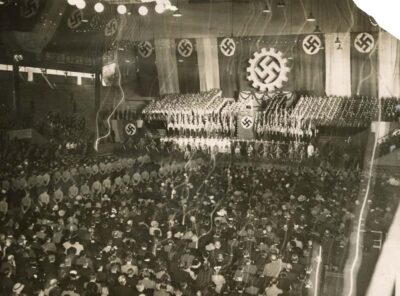
Nazis in Buenos Aires: a historical walking tour
Read our review →
Buenos Aires Walking Tour with Local Guide and Optional Rooftop
Read our review →
Full Day Private Walking Tour of Buenos Aires Neighborhoods
Read our review →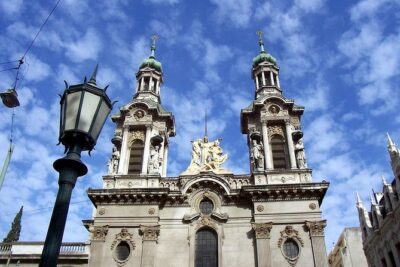
Browse the lists this tour appears in