
Reviewed · BUENOS AIRES WALKING TOURS
Buenos Aires Walking Tour with Local Guide and Optional Rooftop
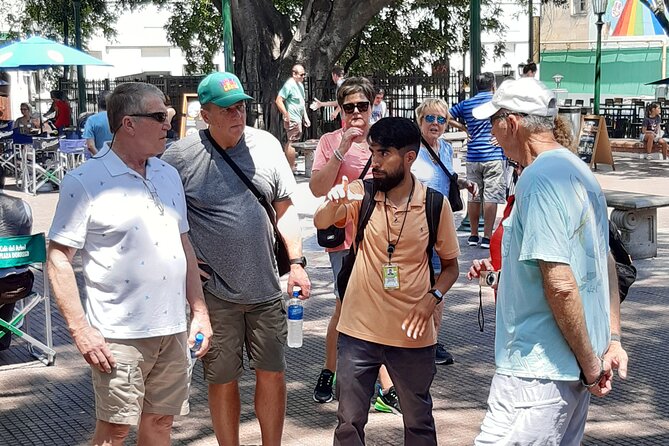
Buenos Aires is too large to understand from one polished downtown stroll. This tour crosses the city by foot, bus, and subway, linking old San Telmo, colorful La Boca, modern Puerto Madero, grand Plaza de Mayo, and Recoleta Cemetery in one long afternoon. The public transport is part of the lesson, not just a way to save time.
I like the small maximum of 15 people and the chance to ask questions as you go. I also like the food stop: three empanadas, a soft drink, and coffee or tea give you a simple taste of local life without adding another restaurant decision. The catch is the amount of ground covered. You need moderate fitness, and traffic can turn a city transfer into standing time.
In This Review
- Key points at a glance
- Why this tour covers so much of Buenos Aires
- San Telmo and Defensa Street: a fitting start
- Mercado San Telmo and the empanada stop
- La Boca and Caminito: color, tango, and football
- Puerto Madero and Puente de la Mujer
- Plaza de Mayo and the political heart of the city
- The Obelisk and 9 de Julio Avenue
- Recoleta Cemetery and Eva Perón’s tomb
- Palacio Barolo rooftop: the optional Wednesday finish
- What the $111 price really buys you
- Who will enjoy this long city crossing
- My verdict: book it for orientation, not slow exploration
- FAQ
- How long does the Buenos Aires walking tour last?
- Where does the tour start?
- Where does the regular tour end?
- Is public transportation included?
- What food and drinks are included?
- Is the Palacio Barolo rooftop included in every tour?
- How many people can join the tour?
- Does the tour run in rainy weather?
- What fitness level is needed?
Key points at a glance
- San Telmo begins the day: Walk cobbled Defensa Street, visit the 1897 market, and taste three empanadas.
- Several neighborhoods in one tour: The route connects San Telmo, La Boca, Puerto Madero, downtown, and Recoleta.
- Local transport is included: Expect public buses and the subway, with no hotel pickup or drop-off.
- Caminito offers color and performance: See the famous La Boca street, with tango dancing and singing nearby.
- The group stays fairly small: The maximum is 15 people, though the assigned guide and language mix can vary.
- The Wednesday rooftop option adds atmosphere: Palacio Barolo includes rooftop access and a cocktail, if you select that option.
Why this tour covers so much of Buenos Aires
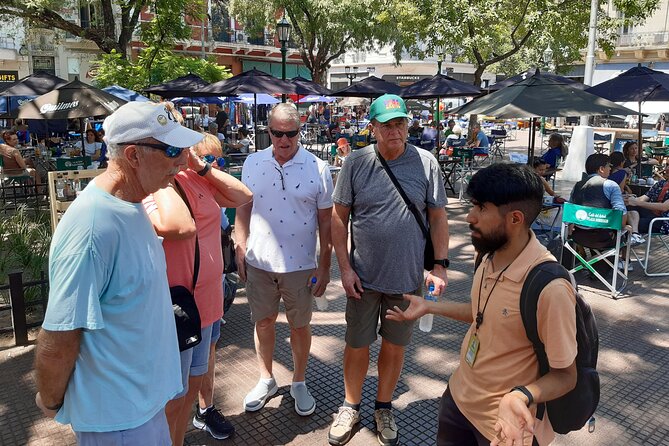
The clever idea here is geographic. Instead of spending five hours circling one neighborhood, you move across several parts of the capital and hear how immigration, tango, football, politics, architecture, and daily routines shaped the city.
That range is useful on a first visit. You see the difference between San Telmo’s old streets, La Boca’s theatrical color, Puerto Madero’s modern towers, the formal center around Plaza de Mayo, and the elegant Recoleta district. You will not study each area in great depth, but you will get a strong sense of how Buenos Aires changes from barrio to barrio.
The route begins at noon at Defensa 831 in San Telmo. It ends at Recoleta Cemetery, unless you choose the optional Palacio Barolo rooftop visit on Wednesday. The advertised length is about five to seven hours, so keep the rest of your day light.
Guides named in especially positive feedback include Victor, Carlos, Gabi or Gabriel, Chan, Denise, Rosita, and Sylvia. The guide assigned to your departure can differ, and the tour may be operated by a multilingual guide. English ability and presentation style may therefore vary, although the strongest guide experiences described here involved warm, personal explanations and a real interest in Argentine culture.
More walking tours in Buenos Aires:
- Buenos Aires Hop-On Hop-Off Bus, Free Walking Tours & Discounts
★ 4.5 · 2,218 reviews - Buenos Aires: La Boca Guided Walking Tour in English
★ 4.8 · 1,587 reviews - Nazis in Buenos Aires: a historical walking tour
★ 4.9 · 193 reviews
San Telmo and Defensa Street: a fitting start
San Telmo is one of the oldest parts of Buenos Aires, and Defensa Street gives you an immediate feel for its age. Expect cobblestones, old buildings, antique shops, traditional street lamps called faroles, and a bohemian arts scene.
The first walk lasts about 30 minutes. Your guide leads rather than leaving you to find the next stop, which is helpful in a city where a short map distance can become confusing at street level. You will have regular chances to stop for photographs, without dealing with a car or searching for parking.
If your tour falls on a Sunday, the famous San Telmo street market may make the approach especially enjoyable. The tour information does not promise a Sunday departure, so treat this as a useful scheduling tip rather than a guaranteed feature.
The limitation is time. San Telmo rewards slow wandering, browsing, and café stops, while this tour keeps moving toward the market and the next neighborhood. If antiques and street shopping are your main goals, plan a separate visit.
Mercado San Telmo and the empanada stop
Mercado San Telmo opened in 1897 to serve the large wave of immigrants arriving in Buenos Aires. Its original role was to supply households with meat, vegetables, and other groceries. Today, some food shops still serve that purpose, but the market also offers Argentine specialties and food from other parts of the world.
You spend about 30 minutes here. Three empanadas of your choice are included, with examples such as beef, chicken, ham and cheese, or vegetables. A soft drink and coffee or tea are also included, making this more than a quick look inside a market.
This is a practical meal rather than a full sit-down lunch. You should confirm your needs with the guide or operator if you are vegan or have dietary restrictions. One past participant had difficulty finding a suitable vegan replacement and paid extra for an unsatisfactory substitute. The listed choices also do not promise a vegan, gluten-free, or allergen-free option.
After the market, the group continues along Defensa Street toward Plaza Dorrego. The stop is a good moment to connect food with migration and local identity, especially if your guide uses the market to explain how different communities influenced Argentine cooking.
La Boca and Caminito: color, tango, and football
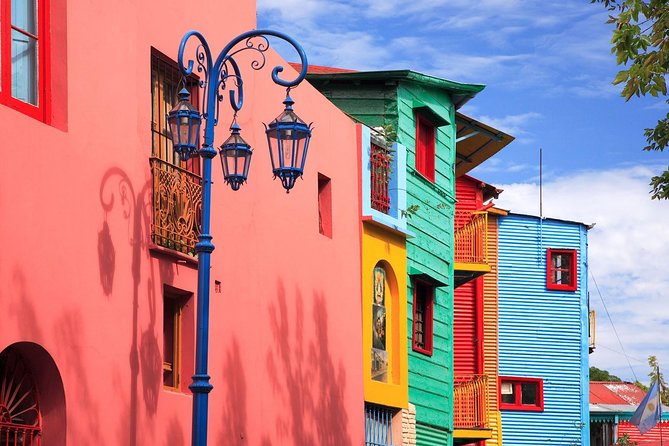
From San Telmo, you take a public bus to La Boca. This is one of the tour’s most striking changes of mood. Caminito is known for brightly painted buildings, street tango, singing performances, and its connection to Boca Juniors football club.
You have about an hour here, enough for an introduction and photographs. The area is designed for visual impact, and your guide can help explain how tango, football, and immigration shaped the neighborhood’s public image.
I would not expect this to be a relaxed shopping break. One useful criticism of the tour is that the schedule offers little free time for souvenirs, especially in La Boca. If you want to browse independently, ask your guide how much time you have before wandering off.
The bus ride itself is part of the experience. You see the city as residents do, although traffic can slow the day. One reason to book this tour is precisely that it treats the bus and subway as part of Buenos Aires rather than hiding the city behind private transport. One reason to skip it is that you may prefer fewer stops and more time at each one.
A different sort of afternoon, still in Buenos Aires:
- Buenos Aires: Piazzolla Tango Show with Optional Dinner
★ 4.4 · 2,122 reviews - Buenos Aires: City Highlights Guided Tour with Transfer
★ 4.7 · 1,946 reviews - Buenos Aires: Hop-On Hop-Off City Bus Tour
★ 4.2 · 1,855 reviews - Buenos Aires Hop-On Hop-Off Bus and Exclusive Benefits
★ 4.4 · 1,714 reviews
Puerto Madero and Puente de la Mujer
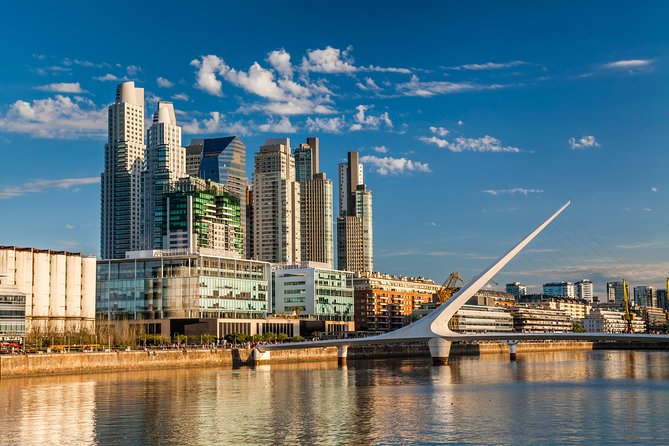
Another bus takes you toward Puerto Madero, where modern towers contrast sharply with San Telmo and La Boca. The scheduled stop at Puente de la Mujer is only about five minutes, so think of it as a photo and orientation pause, not a full neighborhood visit.
The bridge, designed by Santiago Calatrava, has an asymmetrical form meant to suggest a tango couple. Its shape is easy to recognize, and it gives the group a quick architectural counterpoint to the older parts of the city.
Expect modest depth here. Some visitors found the Puerto Madero portion brief, with little time spent beyond the bridge and views. If sleek architecture and waterfront development interest you, you may want to return on your own later. The tour’s purpose is to show you the city’s range, not to provide a long walk through every district.
Plaza de Mayo and the political heart of the city
The tour then returns to walking in the center, around Casa Rosada and Plaza de Mayo. This is one of the most important parts of the route, and the schedule gives it more time than Puente de la Mujer.
You see the Cabildo, the Metropolitan Cathedral, Casa Rosada, and the major avenues that lead away from the square. The guide’s explanations matter greatly here because the buildings are tied to Argentina’s national story, political life, and public demonstrations.
The formal setting also helps you understand Buenos Aires as a capital. Wide streets and monumental buildings replace the intimate lanes of San Telmo. Good guides use the square to connect architecture with events and people, rather than simply naming buildings.
The advertised time is split between a short Casa Rosada visit and roughly 30 minutes around Plaza de Mayo. The order may change, depending on the guide and conditions. You should be prepared to listen while standing, since one criticism of the tour was that some explanations felt too much like a stationary lecture.
The Obelisk and 9 de Julio Avenue
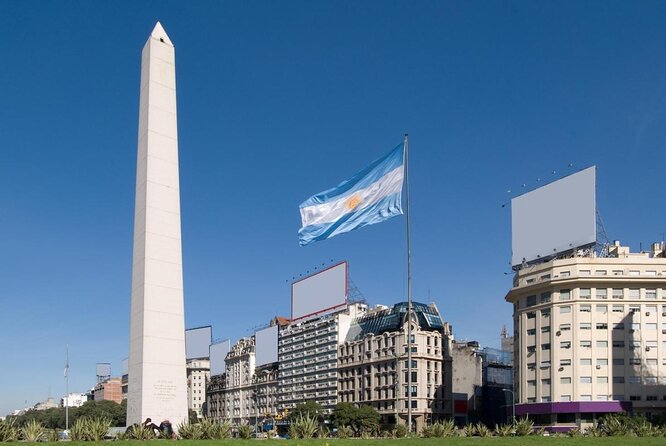
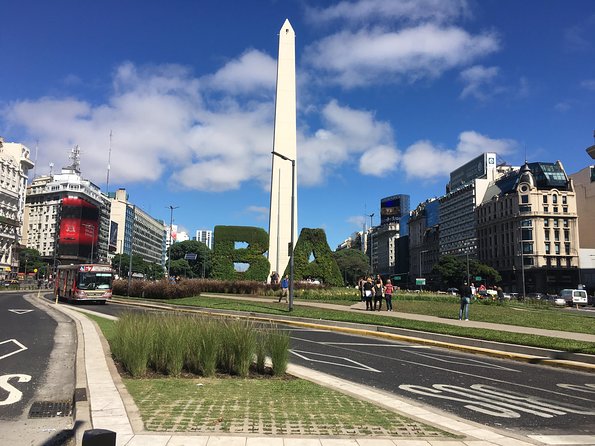
After Plaza de Mayo, the group heads to the Obelisk, one of Buenos Aires’ best-known symbols. The visit lasts about 30 minutes, followed by a 15-minute walk along 9 de Julio Avenue.
The avenue is famous for its extraordinary width, monuments, historic buildings, and heavy city movement. Walking here gives you a sense of scale that a quick vehicle ride cannot provide. You are no longer looking at a small historic quarter. You are moving through a major capital at work.
This section is an orientation walk, not an extended architectural tour. Some parts of the route can feel quick, especially if you hoped to stop inside buildings or browse nearby streets. Still, the Obelisk and avenue help tie the separate neighborhoods together.
Wear comfortable shoes and expect pavement, crossings, and a fair amount of standing. A past seven-hour outing covered about eight miles, with heat making the distance feel much harder. The official advice of moderate fitness is worth taking seriously.
Recoleta Cemetery and Eva Perón’s tomb
The group uses the subway to reach Recoleta, the final regular stop. The neighborhood is known for museums, cafés, restaurants, exclusive avenues, and shopping areas, but the focus here is Recoleta Cemetery.
The cemetery is an extraordinary maze of mausoleums and formal architecture. It is the burial place of many Argentine aristocratic families and historic figures, including Eva Duarte Perón. A guide adds real value because the cemetery can otherwise become a long series of names and stone façades with little context.
You spend about 30 minutes inside. That is enough for an introduction to the principal areas, but not enough to examine every passage or tomb. If Evita, Argentine politics, or cemetery architecture is a priority, you may want to return separately with more time.
The listed ending point is Junín 1760 at Recoleta Cemetery. There is no hotel pickup or return transfer, so arrange your onward plans from the cemetery area.
Palacio Barolo rooftop: the optional Wednesday finish
If you select the rooftop option and book a Wednesday departure, the tour continues to Palacio Barolo. The building opened in 1923, is a National Historic Monument, and contains symbolic references to Dante Alighieri’s Divine Comedy.
The rooftop visit lasts about an hour and includes a cocktail. This changes the ending from a cemetery exit to a more atmospheric architectural finish. It also gives you a chance to look back over the city after spending the day crossing it.
Because the rooftop is optional and tied to Wednesday, check the exact option before paying. It is not part of every departure. The extra cost may be worthwhile if you enjoy architecture, city views, and a drink at the end of a long day. If you mainly want neighborhood history and practical orientation, the regular cemetery ending may be enough.
What the $111 price really buys you
At $111 per person, this is not a bargain walking tour in the narrow sense. You are paying for a professional guide, a small-group format, public bus and subway fares, three empanadas, a soft drink, coffee or tea, and the selected Palacio Barolo access with cocktail.
The value depends on how you would otherwise organize the day. Visiting all these neighborhoods independently would require several transport decisions, route planning, and a separate effort to connect the places into one understandable story. The guide removes much of that friction.
The price is harder to justify if you only want a few central sights, dislike public transport, or prefer free time for shopping and cafés. One past participant felt a city-run free tour offered better value, while others found this a strong way to get oriented quickly. I would treat it as a first-day introduction rather than a definitive visit to every neighborhood.
The fact that the tour is often booked about 47 days ahead suggests you should not leave it until the last minute if your schedule is fixed. Free cancellation is available up to 24 hours before the start time. Changes or cancellations made less than 24 hours ahead are not accepted for a refund.
Who will enjoy this long city crossing
This tour suits you if you want a broad first look at Buenos Aires and are happy to walk, listen, and use ordinary city transport. It is particularly useful at the start of a trip because you can note places to revisit, learn the bus and subway system, and see how far the main districts are from one another.
It also suits solo visitors and couples who like a guide’s social energy. Small groups can make it easier to ask questions, and the best guide experiences have included personal touches, old photographs, articles, clear English, and explanations of everyday Argentine life.
Families should consider the length, heat, and pavement. Children who enjoy movement and colorful streets may like La Boca, but the long explanations and transport changes may test younger attention spans.
You may want another format if you have limited mobility, want extensive time at each sight, or find it tiring to stand while a guide talks. The tour is not canceled for rain, so bring suitable clothing and footwear. Weather protection matters because much of the day takes place outdoors.
My verdict: book it for orientation, not slow exploration
I would book this tour early in a Buenos Aires visit if my goal were to understand the city’s layout and see many major areas in one day. The strongest reasons are the route, the local transport, and the guide-led context, especially when the guide is as engaging as Victor, Carlos, Gabi, Chan, Denise, Rosita, or Sylvia have been described.
I would skip it if I wanted long, unhurried visits to San Telmo, La Boca, Puerto Madero, or Recoleta. The itinerary is ambitious, traffic can eat into sightseeing time, and the food choices may not suit every diet.
Choose the rooftop option on Wednesday if the Barolo architecture and cocktail appeal to you. Otherwise, accept the Recoleta ending and use the tour as a map for the rest of your stay. It is a substantial day, but it gives you something many shorter city tours miss: a practical feel for how Buenos Aires connects.
FAQ
How long does the Buenos Aires walking tour last?
The experience lasts approximately five to seven hours. The exact duration can vary because the guide may change the order of stops and the group uses public buses and the subway.
Where does the tour start?
The tour starts at Defensa 831 in San Telmo, Buenos Aires. The scheduled start time is 12:00 pm.
Where does the regular tour end?
The regular tour ends at Recoleta Cemetery, at Junín 1760. Hotel pickup and drop-off are not included.
Is public transportation included?
Yes. Transport by public bus and subway is included. Using local transport is part of the experience and helps you see how people move around Buenos Aires.
What food and drinks are included?
You receive three empanadas of your choice, one soft drink, and coffee or tea. Listed empanada examples include beef, chicken, ham and cheese, and vegetables.
Is the Palacio Barolo rooftop included in every tour?
No. Rooftop access is included only if you select that option. The itinerary specifies the rooftop option for Wednesday, and it includes a cocktail.
How many people can join the tour?
The maximum group size is 15 people. The tour may be operated by a multilingual guide, so the language mix can vary.
Does the tour run in rainy weather?
Yes. The tour is not subject to weather cancellation and does not cancel because of rain.
What fitness level is needed?
A moderate level of physical fitness is recommended. You should be ready for several hours of walking, standing, pavement, public transport, and possible heat.
Just added around Buenos Aires
- Unique Tigre and Delta Private Day Cruise Navegation★ 5.0 · 3 reviews
- Buenos Aires: Customizable City Tour in Polish★ 4.7 · 3 reviews
- Velez Sarsfield Football Match★ 5.0 · 3 reviews
- Tango Show at: MichelAngelo★ 4.5 · 3 reviews
- From Colonialism to Eclecticism, Buenos Aires arquitectonica★ 5.0 · 3 reviews
- Enjoy a Rural Experience in a Vineyard near Buenos Aires★ 4.7 · 3 reviews
- Guided tour Boca Juniors Museum & Stadium + Caminito★ 3.3 · 3 reviews
- Buenos Aires: Private City Tour by Car with Hotel or Pickup★ 5.0 · 3 reviews
Buenos Aires Walking Tours, compared.

Nazis in Buenos Aires: a historical walking tour
Read our review →
Full Day Private Walking Tour of Buenos Aires Neighborhoods
Read our review →
Browse the lists this tour appears in