
Reviewed · BUENOS AIRES WALKING TOURS
Buenos Aires in One Day Private Walking Tour
Buenos Aires reveals itself best on foot, where French-style palaces, old churches, political monuments, and ordinary city streets sit close together. This six-hour private tour moves from Florida Street and Plaza San Martín to Recoleta, San Telmo, Plaza de Mayo, and Puerto Madero, with the city’s past explained as you go.
I like the wide historical sweep, from British influence and immigration to military coups and the Mothers of the Disappeared. I also like the time at Recoleta Cemetery, where Eva Perón’s burial place is only one part of a remarkable collection of monuments and stories.
The catch is simple: this is a true walking tour, not a quick sightseeing ride. You may walk for six or seven hours, take a taxi at your own expense, and spend much of the day outdoors. Some people also found the second guide less fluent in English than the first.
In This Review
- Key points to know before you book
- Why this walking tour works for a short stay
- Meeting at Florida Garden and starting on Calle Florida
- Retiro, where palaces meet British influence
- Avenida Alvear and the Parisian side of Buenos Aires
- Recoleta Cemetery and the story behind the marble
- Palermo and the city’s public face
- Downtown, Plaza de Mayo, and Argentina’s political center
- The Cathedral and Casa Rosada
- San Telmo, colonial streets, and difficult history
- Puerto Madero and the city beyond the old docks
- Coffee, lunch, and the pace of a private day
- Who should book this Buenos Aires tour
- Should you book it?
- FAQ
- How long does the Buenos Aires walking tour last?
- Where does the tour start?
- Where does the tour finish?
- Is this a private tour?
- Is transportation included?
- Is Recoleta Cemetery admission included?
- Are meals included?
Key points to know before you book
- Six hours of serious city walking: Plan for a long day on your feet, with a moderate fitness level required.
- A private experience: Only your own group participates, so the pace and discussion can be adjusted to your interests.
- Recoleta Cemetery is the main paid sight: Admission is included, with special attention to Eva Perón and other famous Argentinians.
- The route connects very different Buenos Aires: You see grand Retiro, elegant Recoleta, old San Telmo, modern Puerto Madero, and working city streets.
- Budget extra for food and a taxi: Lunch or coffee is not included, and one taxi ride costs about $5 to $7.
- The route is ambitious: Weather, strikes, repairs, protests, and city events can affect how much you cover.
Why this walking tour works for a short stay
At $199 per person, this is not a bargain-priced orientation walk. You are paying for a private guide, a long route, cemetery admission, and the chance to ask questions without being lost in a large group.
I see the value most clearly if you have only a day or two in Buenos Aires. The tour shows you where the major districts are, then explains how they connect. You do not simply check off a plaza and a church. You hear how immigration shaped the architecture, how British business affected the city, why Argentina’s political past still appears on walls and monuments, and how old neighborhoods changed over time.
The private format also matters. If your group wants more politics, architecture, Eva Perón, or everyday life, you can ask for it. Carlos has been praised for clear English and strong insight into Argentine life, while Soledad, Clemencia, and Eilat have also led highly regarded tours. Guides can vary, so the exact style may not be identical from one booking to the next.
The experience is marketed as six hours, but several accounts describe walking for close to seven hours. I would leave the rest of your day open. This is not the tour to book before an evening reservation you cannot miss.
More walking tours in Buenos Aires:
- Buenos Aires Hop-On Hop-Off Bus, Free Walking Tours & Discounts
★ 4.5 · 2,218 reviews - Buenos Aires: La Boca Guided Walking Tour in English
★ 4.8 · 1,587 reviews - Nazis in Buenos Aires: a historical walking tour
★ 4.9 · 193 reviews
Meeting at Florida Garden and starting on Calle Florida
You meet outside Florida Garden at 10 a.m., near the corner with Paraguay Street. Look for the small Buenos Aires Walking Tours sign held by the guide or attached to clothing. The meeting instructions are specific, which is useful in a crowded downtown area, but arrive early enough to avoid a rushed start.
The first stroll follows Calle Florida, one of the city’s best-known pedestrian streets. Your guide uses its historic buildings and commercial life to explain how Buenos Aires developed. This short opening gives you a first sense of the city before the tour moves into Retiro.
Retiro, where palaces meet British influence
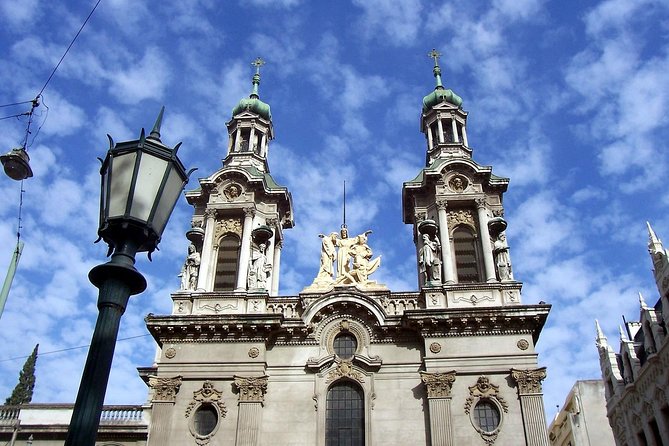
Retiro brings together grand public space, wealthy mansions, military memory, and signs of Argentina’s links with Britain. At Plaza San Martín, you hear about its earlier roles as a military bastion, bullfight ring, and slave market. That history gives the elegant park a far more complicated meaning than its polished appearance suggests.
The stop includes the Paz Palace, a Belle Époque mansion, the Kavanagh Building, and the Santísimo Sacramento Church. The point is not only to admire facades. Your guide explains the architecture and the social forces behind it, including the wealth of ranchers, business owners, and military leaders.
You also see the British Clock Tower and railroad stations. This part of the route is useful if you want to understand how England’s commercial and transport influence shaped Buenos Aires. General San Martín’s monument adds the national story, focusing on Argentina’s path to independence.
Avenida Alvear and the Parisian side of Buenos Aires
Avenida Alvear is one of the clearest places to see why Buenos Aires gained its old nickname, the Paris of the South. The route passes through Barrio Norte and points out French and Italian influences in the city’s buildings, streets, and upper-class culture.
You see palaces and mansions connected with embassies, hotels, religious institutions, and wealthy families. Highlights include Palacio Ortiz-Basualdo, now the French Embassy, Alzaga-Unzué Manor, Duhau Mansion, the Nunciature, Hume Mansion, and Alvear Palace.
I like this section because it adds social context to the pretty buildings. Your guide discusses Catholicism, Judaism, immigration, and the way different communities helped shape Argentine society. Arroyo Street, with its galleries, provides a smaller and more intimate contrast to the grand avenue.
The limitation is that most of this is an exterior architecture walk. You should not expect a series of interior visits. If you prefer entering museums and historic homes, this portion may feel more visual than hands-on.
A different sort of afternoon, still in Buenos Aires:
- Buenos Aires: Piazzolla Tango Show with Optional Dinner
★ 4.4 · 2,122 reviews - Buenos Aires: City Highlights Guided Tour with Transfer
★ 4.7 · 1,946 reviews - Buenos Aires: Hop-On Hop-Off City Bus Tour
★ 4.2 · 1,855 reviews - Buenos Aires Hop-On Hop-Off Bus and Exclusive Benefits
★ 4.4 · 1,714 reviews
Recoleta Cemetery and the story behind the marble
Recoleta is one of the tour’s major stops, and the cemetery receives about 45 minutes of focused attention. Admission is included, so you do not need to arrange a separate ticket.
The cemetery is famous for elaborate tombs and for the burial place of Eva Perón. Your guide explains Evita’s story along with the monuments, families, and public figures found among the narrow lanes. This is more useful than wandering alone and recognizing only one famous name.
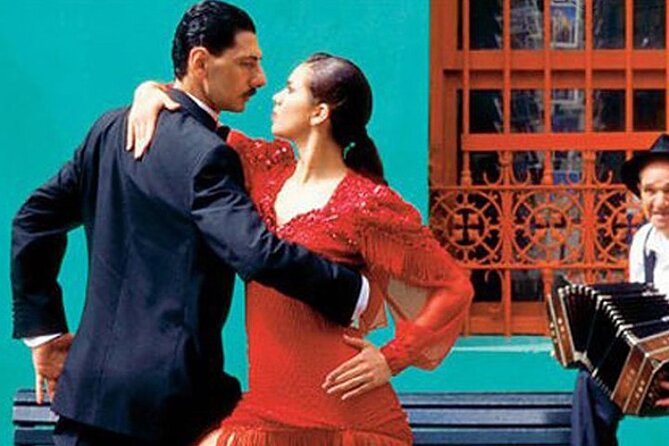
Nearby, you see Nuestra Señora del Pilar Church, the Recoleta neighborhood, the Buenos Aires Exhibition Center, Palais de Glace, and the Buenos Aires Design Center. Palais de Glace is tied to the development of tango, giving the district a cultural angle beyond its grand facades.
Some people found the cemetery portion a little long. I can understand that. The stories are a major reason to take this tour, but if you have already spent time at Recoleta Cemetery, you may prefer a shorter visit and more time elsewhere. Tell your guide what interests you most.
Palermo and the city’s public face
The route continues through Palermo, Buenos Aires’ largest and most populous neighborhood. This section gives you a look at everyday city life after the formal squares and palaces of central Buenos Aires.
Stops include the National Gallery of Art, the large monument by French sculptor Edmond Peynot, the Floralis Genérica, Eva Perón’s monument, and the National Library building. These landmarks cover art, national identity, modern design, politics, and public memory.
The Floralis monument, shaped like a giant flower, is one of the most recognizable modern sights in the city. Eva Perón’s monument adds another layer to her presence in Buenos Aires. Her burial place is in Recoleta, while her monument here marks a different part of her political and personal story.
Because this is a walking tour, you see these places in relation to one another rather than as isolated photo stops. Still, the schedule is packed, and you may not have long at each landmark.
Downtown, Plaza de Mayo, and Argentina’s political center
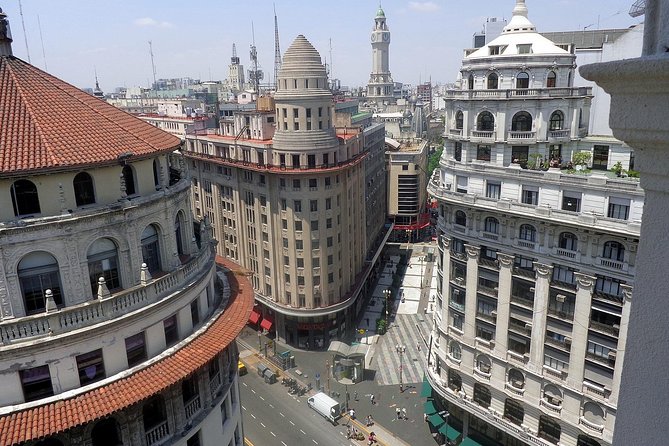
The downtown section brings you to the places most closely tied to Argentina’s national story. You pass Galerías Pacífico and the former Harrods buildings, reminders of the city’s British commercial connections. The Centro Naval reflects the wealth and influence of ranchers and the military.
The route also includes the Teatro Colón, one of the city’s great opera houses, and the Obelisk. Your guide explains what the Obelisk represents rather than treating it as just another landmark. You also hear about Mariquita Sánchez and the house linked with Argentina’s national anthem.
The Bank and Finance District gives the tour a useful present-day angle. Here the discussion turns toward Argentina’s recent history and economy. That makes the walk more than an architectural survey, especially if you want help understanding the political references you will encounter elsewhere in the country.
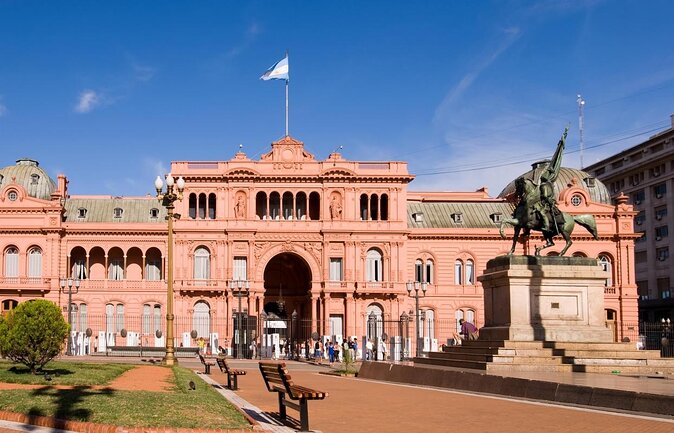
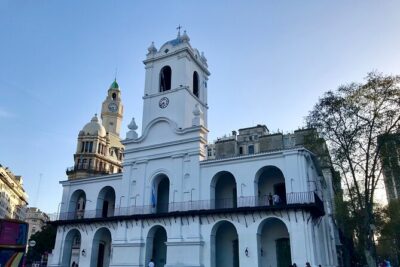
Plaza de Mayo is the core of this part of the day. You see the Casa Rosada, the presidential office, the Cabildo, the Metropolitan Cathedral, the May Pyramid, and the area associated with the Mothers of the Disappeared.
The square carries several layers of Argentine history at once: colonial government, independence, presidential power, military rule, and public protest. The guide’s explanation is especially valuable here because the monuments can seem scattered until you understand the events connected with them.
The Cathedral and Casa Rosada
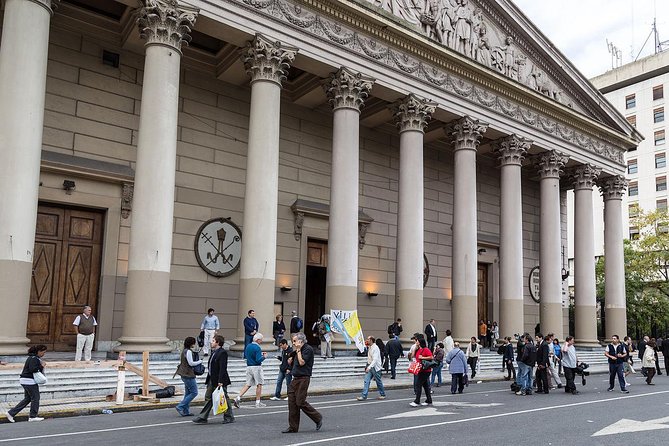
The Metropolitan Cathedral deserves its own pause. It is the main Catholic church in Buenos Aires and contains the guarded tomb of General José de San Martín, a central figure in the liberation of southern South America.
The church is also associated with Pope Francis, who served and preached there before becoming pope. Your guide explains that connection as part of the building’s religious and civic importance.
At Casa Rosada, you see the presidential offices and learn about the building’s history and architecture. The stop is brief, about 10 minutes, and is mainly an exterior visit. If you want a full tour inside the presidential palace, that is not what this experience provides.
San Telmo, colonial streets, and difficult history
San Telmo is the oldest neighborhood on the route and one of the most rewarding places to walk. Colonial-style houses, churches, old shops, narrow streets, and small market spaces give the district a different feel from Retiro and Recoleta.
The guide covers a large amount of ground, including the Cabildo, the Cathedral, the National Bank, Casa Rosada, the Manzana de las Luces, Defensa Street, and Saint Dominic Convent. You hear about the British invasions of 1806 and 1807, immigration, changing architecture, and the city’s early education system.
One of the more unusual details is the Smallest House, a very narrow home said to have been given by its owner to a freed slave. This leads into a discussion of slavery in Buenos Aires, a subject that is often left out of a quick city tour.
You also pass the old city limits on Chile Street, the Minimal House, Carlos Calvo Market, Belén Church, Viceroy Liniers’ house, and the Ezeiza convent. These details reward close attention. The value is in the explanation of what looks ordinary, not only in the famous monuments.
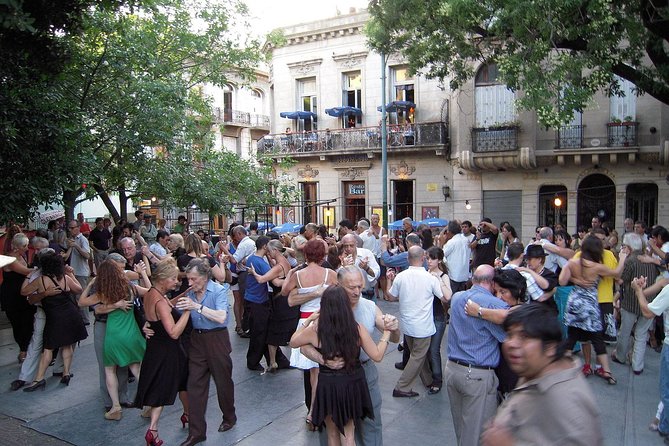
Plaza Dorrego is the heart of San Telmo’s antiques market. It is also a good place to pause at the end of the route, with cafes and antique shops nearby. The itinerary gives this square only a short formal stop, but the tour ends here, so you can continue exploring on your own.
Puerto Madero and the city beyond the old docks
Puerto Madero offers a sharp change of mood. This newer neighborhood was created by extending Buenos Aires across old British dockyards and into the water beyond the original coast.
The stop is brief, around 15 minutes, but it helps you see how the city keeps expanding and reusing its past. After colonial streets and nineteenth-century palaces, Puerto Madero shows a more recent Buenos Aires built around former industrial and port space.
One taxi ride is required between attractions, and it is not included. The stated cost is about $5 to $7. Bring Argentine pesos or another accepted payment method, and keep this expense in mind when comparing the tour’s price.
Coffee, lunch, and the pace of a private day
A coffee and lunch break is included in the flow of the day, but you pay for your own food and drinks. This is welcome on such a long route, although the break is not a formal meal package or a guaranteed restaurant experience.
I would use the pause to tell your guide what you still want to understand. The route covers architecture, religion, immigration, slavery, military history, politics, tango, and modern city life. A private tour works best when you steer part of the conversation toward your interests.
The guide arrangement can change during the day. Some tours have used one guide in the morning and another later, especially around lunch or the Recoleta portion. That can bring useful local expertise, but it may also mean a change in English fluency or pace.
Who should book this Buenos Aires tour
I would choose this tour if you want a strong first orientation to Buenos Aires and prefer explanations to quick photo stops. It suits couples, families with older children, and private groups that enjoy history, architecture, politics, and long walks.
Children eight and under are free with a paying adult, but the day still requires patience and stamina. The route is not designed as a gentle stroll. Wear comfortable shoes, carry water, and expect rain or sun because the tour runs in all weather.
I would skip it if you want lots of museum interiors, a relaxed pace, or transport between every sight. One low-rated experience found the tour did not enter enough buildings, and that is a fair concern. The tour’s strength is street-level explanation, not a series of indoor admissions.
Should you book it?
Book this private walk if you have limited time and want to understand how Buenos Aires fits together. The strongest parts are the guide-led context at Plaza de Mayo, San Telmo’s difficult social history, Retiro’s architecture, and the detailed visit to Recoleta Cemetery.
At $199 per person, the price makes the most sense for a small group that will use the private format and ask questions. Add money for lunch, coffee, and the taxi. If you can handle a full day on foot and accept that some sights are exterior-only, this is a useful and unusually thorough introduction to the city.
FAQ
How long does the Buenos Aires walking tour last?
The advertised duration is approximately six hours, beginning at 10 a.m. Some tour experiences have lasted close to seven hours, so keep your schedule flexible.
Where does the tour start?
The meeting point is outside Florida Garden at Florida 899, near the corner with Paraguay Street. Look for a small Buenos Aires Walking Tours sign held by the guide or attached to clothing.
Where does the tour finish?
The planned end point is Plaza Dorrego in San Telmo, at Humberto 1º 400. The square has cafes, antique shops, and the San Telmo Antiques Market nearby.
Is this a private tour?
Yes. Only your group participates in the private activity.
Is transportation included?
Transportation is not included. One taxi ride is required during the tour, and the stated cost is approximately $5 to $7. Hotel pickup and drop-off are also not included.
Is Recoleta Cemetery admission included?
Yes. Cemetery admission tickets are included in the tour price.
Are meals included?
No. The tour includes a coffee and lunch break, but you pay for your own food and drinks.
More 1-Day Tours in Buenos Aires
- Gaucho Day Trip from Buenos Aires: Santa Susana Ranch
★ 4.0 · 272 reviews - Gaucho Experience: A Day Trip to Don Silvano Ranch
★ 4.0 · 148 reviews - Colonia del Sacramento: Small-Group Day Trip
★ 4.5 · 48 reviews - Iguazu Falls Private Day Trip from Buenos Aires with Airfare
★ 4.5 · 35 reviews
Just added around Buenos Aires
- Unique Tigre and Delta Private Day Cruise Navegation★ 5.0 · 3 reviews
- Buenos Aires: Customizable City Tour in Polish★ 4.7 · 3 reviews
- Velez Sarsfield Football Match★ 5.0 · 3 reviews
- Tango Show at: MichelAngelo★ 4.5 · 3 reviews
- Guided tour Boca Juniors Museum & Stadium + Caminito★ 3.3 · 3 reviews
- From Colonialism to Eclecticism, Buenos Aires arquitectonica★ 5.0 · 3 reviews
- Enjoy a Rural Experience in a Vineyard near Buenos Aires★ 4.7 · 3 reviews
- Buenos Aires: Private City Tour by Car with Hotel or Pickup★ 5.0 · 3 reviews
Buenos Aires Walking Tours, compared.
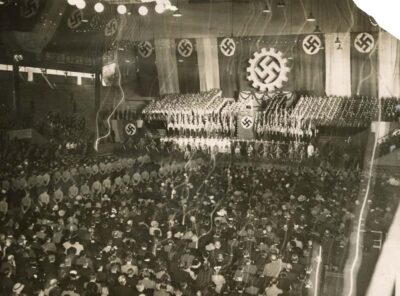
Nazis in Buenos Aires: a historical walking tour
Read our review →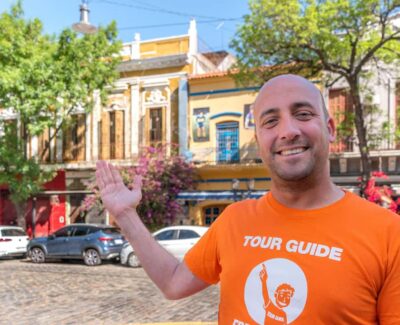
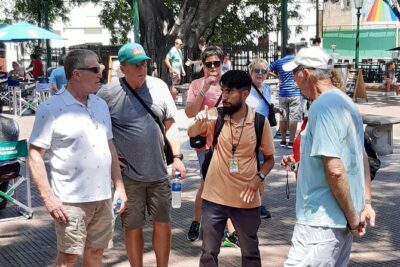
Buenos Aires Walking Tour with Local Guide and Optional Rooftop
Read our review →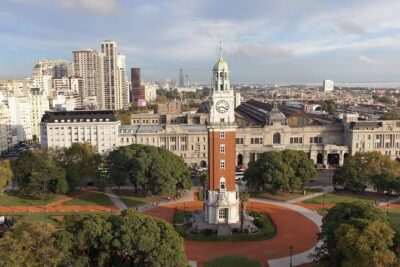
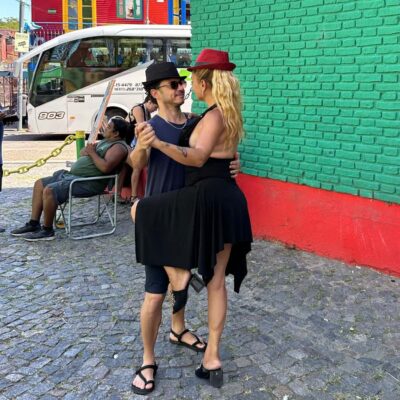
Full Day Private Walking Tour of Buenos Aires Neighborhoods
Read our review →
Browse the lists this tour appears in